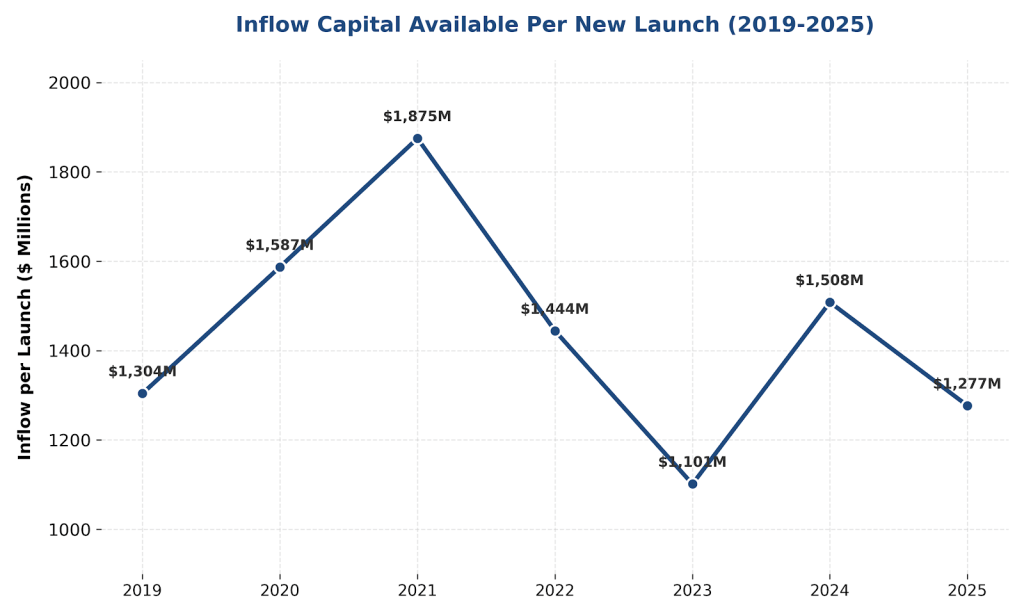
ETF launches are skyrocketing, but the math is brutal: 90% of new active funds operate at a loss while legacy giants take all the cash.
Smaller ETF fund sponsors already know the market is incredibly tough, but recent data reveals a stark reality: product manufacturing has completely decoupled from organic asset gathering. We are currently witnessing a classic “spaghetti on the wall” phenomenon where issuers throw hundreds of niche, active, and derivative-based strategies at the market to see what sticks.
The underlying numbers paint a brutal story. In 2025, issuers rolled out a record-shattering 1,167 new ETFs. Yet, the ratio of annual industry inflows to new product launches has plummeted by over 30% from its post-pandemic peak, dropping from $1.88 billion per launch in 2021 down to just $1.28 billion by 2025.
Where is the money actually going? It is being siphoned directly to the top. A tiny elite of legacy index-tracking giants continues to suck up the lion’s share of investor capital. For instance, Vanguard’s VOO alone swallowed over $113 billion in a single year—capturing more investor cash than hundreds of new active launches combined.
This top-heavy dynamic creates a lethal environment for independent sponsors. While the aggregate average AUM per ETF looks healthy on paper (inflated by mega-caps and a roaring equity bull market), the median fund is starving. Today, nearly 90% of new active ETF launches fail to cross the crucial $50M to $100M operational breakeven threshold within their first year. This means the vast majority are running at a pure loss.
With liquidations climbing back up to 232 per year, the runway for new funds is shorter than ever. For boutique sponsors, survival requires moving away from copycat strategies and focusing on hyper-distribution; otherwise, you’re just adding to the noise on a very crowded wall.
Every ETF issuer knows the Day-1 problem. A new fund needs scale to earn shelf space, satisfy exchange listing economics, and attract the institutional flows that follow AUM. The traditional answer is seed capital and years of slow organic inflows. New research from ExchangiFi points to an alternative pipeline, and it is measured in trillions.
The paper estimates $5.0 trillion in U.S. taxable equity assets are structurally suited to Section 351 tax-deferred conversion into ETF wrappers. These are not flows competing on expense ratio. They are assets locked in place by embedded gains, held by investors whose alternative to converting is to do nothing. The top 10% of households hold roughly 87% of the $57.7 trillion in household equity wealth, much of it at realization hurdles above 35% in high-tax states.
For a fund sponsor, the strategic logic runs in both directions. The conversion solves a pressing problem for the contributing investor. It also delivers a large block of assets into the fund in a single tax-efficient transaction. A launch seeded through Section 351 contributions can open with the AUM and liquidity profile that would otherwise take years to build. Polen Capital, Cambria, and Alpha Architect have already run versions of this playbook.
The sizing model matters for product design. The $2.9 trillion in concentrated single-stock positions requires pooled, pre-diversified vehicles, since the 25% and 50% diversification tests cannot be cleared by a single contributor alone. The $1.0 trillion in aged direct-indexing accounts arrives already diversified and maps naturally into broad-market or factor products. The $1.1 trillion in active SMAs suits active ETF conversions, where the in-kind redemption mechanism permanently eliminates the turnover tax drag the SMA structure imposed.
The binding constraint is not demand or manager appetite. It is operational capacity. Compliant basket construction, diversification testing at the moment of contribution, contributor coordination, and clean in-kind execution. ExchangiFi operates the marketplace and automation layer that connects issuers to contributing wealth managers and runs that machinery at scale.
Connect with ExchangiFi to scale your next fund launch.
State Street’s 2026 Global ETF Outlook makes the case that ETFs have outgrown their original identity. With global ETF assets approaching $22 trillion, the vehicle once described as a disruptive wrapper now functions as core market infrastructure.
Three global trends shaping the year ahead for ETFs.
First, active ETFs continue to pull capital across regions. Active fixed income and derivative income strategies like covered calls and defined outcome funds are driving most of the flow. The fixed income shift is striking. In 2022, active strategies captured 6 percent of total fixed income ETF inflows. By 2025, that figure reached 42 percent.
Second, the wrapper is absorbing strategies that used to live behind institutional walls. Multi coin crypto, pre IPO exposure, and private market style ETFs are pushing into the liquid open ended format. These strategies carry capacity constraints. Issuers will need to manage liquidity, scaling, and investor education as the lines between public and private exposure continue to blur.
Third, growth will hinge on operational plumbing more than ticker launches. Three structural shifts stand out.
Mutual fund to ETF conversions crossed 170 funds and over $125 billion in assets, with more than 50 conversions in 2025 alone. Half of surveyed issuers plan to convert at least one fund over the next twelve months.
Section 351 exchanges are gaining traction as wealth managers look for ways to contribute appreciated securities into diversified ETFs without triggering capital gains. The mechanism functions as an efficient external seeding channel and a tax aware path for advisors managing concentrated client positions.
ETF share classes within existing mutual fund structures are expected to launch in early 2026 following regulatory relief. The rollout may be slow given operational complexity and differing economics across gatekeepers, but the structure preserves historical track records and opens a long runway for legacy managers.
The regional picture varies. North America entered 2026 on back to back years of $1 trillion plus US inflows and a record $100 billion in Canada. ETFs now represent roughly 30 percent of Millennial portfolios. Europe is on pace to top $4 trillion in AUM by year end, driven by retail distribution and retirement platforms. Asia Pacific growth is uneven, shaped by local tax programs, leverage rules, and policy backed thematic demand.
The conclusion is direct. Success in 2026 will depend on execution over expansion. The firms that win will be those that can operate at scale, manage the backend complexity of dual structures, and stay structurally resilient through volatility.
A Section 351 ETF exchange looks intimidating from the outside. Multiple parties, unfamiliar documents, an unusual tax framework, and an operational structure that most investors have never seen before. From the inside, it is actually a fairly defined process with predictable stages.
This guide walks through each stage in the order it typically happens. The same general flow applies to most transactions, though the duration of each stage varies with fund complexity, sponsor capacity, and contributor count. Where decisions involve specific tax outcomes for a contributor, we recommend you consult your tax advisor before relying on any conclusion in this overview.
The parties involved
Before walking through the stages, it helps to know who is around the table.
The fund sponsor is the firm launching the new ETF. The sponsor builds the strategy, files the registration documents, and serves as the operational backbone of the fund.
Legal counsel handles the registration filings, the contribution agreements, and the tax opinion work. Tax counsel and securities counsel may be different firms.
The custodian holds the contributed assets before the exchange and the new ETF shares afterward. Lot level basis records flow through the custodian.
The advisor manages client portfolios, screens contributors, collects consents, and serves as the day to day point of contact for individual contributors.
The contributor is the investor or client whose appreciated portfolio is being contributed in exchange for ETF shares.
Each party has a role at each stage. The process moves forward when each one does its part on time.
Stage one. Initial screening and sponsor selection
The process begins with strategy and fit. An advisor or investor identifies an appreciated taxable portfolio that may benefit from conversion into an ETF wrapper. A potential fund sponsor is identified. The sponsor and the advisor have an early conversation about whether the contemplated assets would fit a workable fund strategy.
This stage is about answering one question. Is there a viable fund here. The answer depends on the portfolio composition, the prospective fund mandate, and the contributor count and size. A single large appreciated portfolio sometimes anchors a fund. More often, several contributors are combined into a single launch.
If the conversation moves forward, the advisor begins early screening of contributor portfolios against the eligibility framework. The 25 and 50 diversification test under IRC Section 351(e) and Treasury Regulation Section 1.351-1(c) is applied at this stage on a preliminary basis. Asset eligibility is reviewed at the position level.
Most viable fund concepts emerge from this stage with a rough contributor list, a target launch quarter, and a draft strategy outline.
Stage two. Engagement of counsel and service providers
Once the basic structure is agreed, the formal engagement work begins. The fund sponsor engages legal counsel for both securities and tax matters. The custodian relationship is confirmed or established. The administrator, transfer agent, and authorized participant arrangements move into formal documentation.
Counsel begins the prospectus drafting work. This document describes the fund’s strategy, fees, risks, and operations. It also frames the kinds of assets the fund will accept at seeding.
Tax counsel begins to develop the analysis that will support the non recognition treatment under IRC Section 351(a). This typically involves reviewing the contributor list, the contemplated contribution baskets, and the proposed fund structure to confirm that all the requirements can be satisfied.
This stage is paperwork heavy. It is also where preventable problems get caught. A contributor whose portfolio fails diversification at this stage can sometimes be repositioned before launch. A contributor whose ownership structure does not fit can be removed from the launch list before any commitments are made.
Stage three. Prospectus and registration
With the legal foundation in place, the registration work moves forward. The prospectus is finalized and filed with the appropriate regulators. Service provider agreements are executed. The exchange listing is arranged.
This stage typically takes the longest in real time, even though the actual work is concentrated in a few weeks. Regulatory review timelines are not in the sponsor’s control, and the fund cannot launch until clearances are received.
For contributors, this stage is mostly waiting. The advisor stays in touch with updates on timing. The contributor’s portfolio is held steady, with no major rebalancing or position changes that could disrupt the contemplated contribution basket.
Stage four. Client consent and basis collection
As the launch date approaches, the focused contributor work begins. Each individual contributor receives written disclosures explaining the transaction, the tax deferred nature of the exchange, the carryover basis treatment, and the recommendation to consult your tax advisor independently.
The contributor signs a consent acknowledging the transaction structure. Without explicit written consent, the contribution does not proceed.
In parallel, the advisor or the custodian assembles lot level basis records for every position the contributor will be transferring. Average cost basis is not adequate. Each tax lot needs purchase date and cost basis recorded individually. These records will carry over into the new ETF shares and will determine the contributor’s basis position after the exchange.
This stage is where last minute problems most often surface. A custodian’s basis records may be incomplete for old positions. A contributor may have moved assets between accounts in ways that scrambled the lot level data. A position that was eligible at preliminary screening may have become ineligible because of corporate actions.
Each issue gets resolved or the affected position is excluded from the contribution. The list of contributors and contributed positions is finalized and locked.
A Section 351 ETF launch lives or dies on the quality of basis records and the completeness of contributor consent. Both have to be in place before the seeding date.
Stage five. Seeding and in kind transfer
On the seeding date, the contemplated contributions actually happen. Each contributor’s accepted positions are transferred in kind from their custodial account into the new ETF. In return, the contributor’s account receives ETF shares.
The mechanical sequencing is precise. Authorized participants coordinate the basket delivery. The custodian books the transfer. The transfer agent issues the ETF shares. The administrator updates the fund’s records. Each step happens in a defined order, often within the same day or over a small window.
For the contributor, the result appears in their account as a position transformation. The individual stocks, ADRs, and ETFs that made up the contributed basket disappear from the account. ETF shares of the new fund appear in their place. The basis on those new shares carries over from the contributed positions, aggregated according to the relative values at the seeding date.
This is the legal moment of the exchange. The non recognition treatment under IRC Section 351(a) attaches at this point if all the requirements have been met. The 80 percent control test under IRC Section 368(c) is measured immediately after the exchange, based on the collective ownership of the contributor group.
Stage six. Post launch operations and reporting
Once the fund is launched, the contributor’s situation looks like any other ETF holding. The fund operates under its prospectus. The portfolio manager handles the underlying basket. The contributor can hold the shares, sell some or all of them, or continue to receive distributions.
Tax reporting in the year of the exchange should reflect the non recognition treatment. The contributor’s tax return will include disclosures appropriate to the transaction. The new ETF shares carry the carryover basis, which will be the reference point for any future sales.
The advisor’s role shifts at this point. Instead of coordinating the contribution mechanics, the advisor returns to ongoing portfolio management of the contributor’s broader account. The ETF shares become one position among many in the contributor’s overall plan.
Future sales of the ETF shares trigger gain or loss measured against the carryover basis. The character of that gain depends on the holding period of the original contributed positions and the overall structure of the transaction. Consult your tax advisor for the specific reporting in your situation.
What can change the timeline
Several factors can extend or shorten the typical timeline.
Regulatory review timing is the largest single variable. Faster review accelerates everything downstream. Slower review pushes the seeding date back and sometimes requires re collection of consents and updated basis records.
Contributor count and complexity affects screening time. A fund seeded by a single large contributor often moves faster than one combining a dozen smaller contributors with diverse portfolios.
The diligence quality of the advisor and sponsor affects how often last minute problems surface. Strong upfront screening typically produces a cleaner final stage. Weak upfront work produces surprises in the final weeks.
Custodian capability and responsiveness affects the basis collection process. Some custodians produce clean lot level data quickly. Others struggle, especially with old positions.
Frequently asked questions
How long does a Section 351 exchange take from start to finish Typical timelines run several months from initial screening through fund launch. Regulatory review is the largest variable. Some launches take longer when contributor count or complexity is high.
Who actually signs the contribution agreement The contributor signs the agreement and the consent. The advisor typically coordinates the signing. The fund sponsor and counsel handle the corresponding fund side documentation.
Do I need to do anything special at tax time Your tax preparer will reflect the non recognition treatment in the year of the exchange and will record the carryover basis on the new ETF shares. Future sales of those shares are reported normally against the carryover basis. Consult your tax advisor for specifics.
What happens if the launch is delayed Consents and basis records may need to be refreshed. The advisor coordinates any necessary updates. The contemplated contribution baskets may need to be re verified if portfolio compositions have shifted in the meantime.
Can I add positions after I have signed the consent Generally not without renewed coordination. The contribution basket is locked at a specific point before launch. Adding positions late introduces risk to the diversification analysis and the asset eligibility review.
What if my position fails screening at the last stage The position is typically excluded from the contribution. The contributor either holds it outside the fund or addresses it through a separate strategy. The rest of the contribution may still proceed.
Conclusion
A Section 351 ETF exchange follows a recognizable arc. It begins with strategy fit, moves through legal and operational setup, focuses on contributor consent and basis collection in the weeks before launch, executes through the in kind transfer on the seeding date, and continues through post launch reporting and ongoing portfolio management.
The process rewards preparation. Strong upfront screening, clean basis records, careful diversification analysis, and thorough client consent work all reduce the risk of last minute problems. Each stage feeds the next, and a problem caught at stage two is much easier to resolve than the same problem surfacing at stage five.
For contributors thinking about whether to participate in an upcoming launch, the right starting point is to understand the eligible assets list and to bring the conversation to your own tax advisor early in the process.
Our site uses cookies to enhance your experience. Many are necessary to make our site function. Additional cookies help us understand site usage, make site improvements, provide enhanced functionality and personalisation, serve personalised ads or content based upon web browsing activity.
By clicking “Accept all cookies” you consent to our use of cookies as described in our cookies and online tracking disclosure. Click on “Cookie settings” to manage your cookie preferences. This link can be found at the bottom of every page.
Not Financial Advice
This website provides general information only and is not financial, investment, legal, or tax advice.
Cookie Preferences
Manage your cookie preferences below:
Essential cookies enable basic functions and are necessary for the proper function of the website.
Name
Description
Duration
theme-mode
12 months
Geolocation Config
This cookie is used to store the consent settings based on the visitor's location.
30 days
Cookie Preferences
This cookie is used to store the user's cookie consent preferences.
30 days
CloudFlare provides web performance and security solutions, enhancing site speed and protecting against threats.
The cf_use_ob cookie informs Cloudflare to fetch the requested resource from the Always Online cache on the designated port. Applicable values are: 0, 80, and 443. The cf_ob_info and cf_use_ob cookies are persistent cookies that expire after 30 seconds.
session
__cfwaitingroom
The __cfwaitingroom cookie is only used to track visitors that access a waiting room enabled host and path combination for a zone. Visitors using a browser that does not accept cookies cannot visit the host and path combination while the waiting room is active.
session
cf_chl_rc_i
These cookies are for internal use which allows Cloudflare to identify production issues on clients.
session
cf_chl_rc_ni
These cookies are for internal use which allows Cloudflare to identify production issues on clients.
session
cf_chl_rc_m
These cookies are for internal use which allows Cloudflare to identify production issues on clients.
session
__cfruid
Used by the content network, Cloudflare, to identify trusted web traffic.
session
__cf_bm
Cloudflare's bot products identify and mitigate automated traffic to protect your site from bad bots. Cloudflare places the __cf_bm cookie on End User devices that access Customer sites that are protected by Bot Management or Bot Fight Mode. The __cf_bm cookie is necessary for the proper functioning of these bot solutions.
session
__cflb
When enabling session affinity with Cloudflare Load Balancer, Cloudflare sets a __cflb cookie with a unique value on the first response to the requesting client. Cloudflare routes future requests to the same origin, optimizing network resource usage. In the event of a failover, Cloudflare sets a new __cflb cookie to direct future requests to the failover pool.
session
_cfuvid
The _cfuvid cookie is only set when a site uses this option in a Rate Limiting Rule, and is only used to allow the Cloudflare WAF to distinguish individual users who share the same IP address.
session
cf_clearance
Whether a CAPTCHA or Javascript challenge has been solved.
session
__cfseq
Sequence rules uses cookies to track the order of requests a user has made and the time between requests and makes them available via Cloudflare Rules. This allows you to write rules that match valid or invalid sequences. The specific cookies used to validate sequences are called sequence cookies.
session
cf_ob_info
The cf_ob_info cookie provides information on: The HTTP Status Code returned by the origin web server. The Ray ID of the original failed request. The data center serving the traffic
session
Google Tag Manager simplifies the management of marketing tags on your website without code changes.
Name
Description
Duration
td
Registers statistical data on users' behaviour on the website. Used for internal analytics by the website operator.
session
cookiePreferences
Registers cookie preferences of a user
2 years
WP Consent API is a plugin that standardizes the communication of accepted consent categories between plugins.
Name
Description
Duration
wp_consent_{category}
Stores your consent preference for a specific cookie category (e.g., functional, marketing). It ensures consistent consent management across WordPress plugins supporting the WP Consent API.
30 days
Statistics cookies collect information anonymously. This information helps us understand how visitors use our website.
Google Analytics is a powerful tool that tracks and analyzes website traffic for informed marketing decisions.
Contains information related to marketing campaigns of the user. These are shared with Google AdWords / Google Ads when the Google Ads and Google Analytics accounts are linked together.
90 days
__utma
ID used to identify users and sessions
2 years after last activity
__utmt
Used to monitor number of Google Analytics server requests
10 minutes
__utmb
Used to distinguish new sessions and visits. This cookie is set when the GA.js javascript library is loaded and there is no existing __utmb cookie. The cookie is updated every time data is sent to the Google Analytics server.
30 minutes after last activity
__utmc
Used only with old Urchin versions of Google Analytics and not with GA.js. Was used to distinguish between new sessions and visits at the end of a session.
End of session (browser)
__utmz
Contains information about the traffic source or campaign that directed user to the website. The cookie is set when the GA.js javascript is loaded and updated when data is sent to the Google Anaytics server
6 months after last activity
__utmv
Contains custom information set by the web developer via the _setCustomVar method in Google Analytics. This cookie is updated every time new data is sent to the Google Analytics server.
2 years after last activity
__utmx
Used to determine whether a user is included in an A / B or Multivariate test.
18 months
_ga
ID used to identify users
2 years
_gali
Used by Google Analytics to determine which links on a page are being clicked
30 seconds
_ga_
ID used to identify users
2 years
_gid
ID used to identify users for 24 hours after last activity
24 hours
_gat
Used to monitor number of Google Analytics server requests when using Google Tag Manager
1 minute
HubSpot is an all-in-one marketing, sales, and customer service platform that streamlines business growth.
This cookie is used to save the visitor's selected language choice when viewing pages in multiple languages.
2 years
__hstc
The main cookie for tracking visitors.
13 months
hubspotapi
This cookie allows the user to access the app with the correct permissions.
7 days
hubspotutk
This cookie keeps track of a visitor's identity. It is passed to HubSpot on form submission and used when deduplicating contacts.
13 months
hubspotapi-prefs
This is used with the hubspotapi cookie to remember whether the user checked the 'remember me' box (controls the expiration of the main cookie's authentication).
1 Year
__hssc
This cookie keeps track of sessions.
30 minutes
__hs_opt_out
This cookie is used by the opt-in privacy policy to remember not to ask the visitor to accept cookies again.
13 months
__hssrc
Whenever HubSpot changes the session cookie, this cookie is also set to determine if the visitor has restarted their browser.
session
hubspotapi-csrf
This is used for CSRF prevention - preventing third party websites from accessing your data. Expires after a year.
1 year
messagesUtk
This cookie is used to recognize visitors who chat with you via the chatflows tool. If the visitor leaves your site before they're added as a contact, they will have this cookie associated with their browser.
13 months
__hs_do_not_track
This cookie can be set to prevent the tracking code from sending any information to HubSpot.
13 months
__hs_cookie_cat_pref
This cookie is used to record the categories a visitor consented to.
6 months
__hs_initial_opt_in
This cookie is used to prevent the banner from always displaying when visitors are browsing in strict mode.
7 days
__hs_gpc_banner_dismiss
This cookie is used when the Global Privacy Control banner is dismissed.
180 days
hs_ab_test
This cookie is used to consistently serve visitors the same version of an A/B test page they’ve seen before.
session
__hs_notify_banner_dismiss
This cookie is used when the website uses a Notify consent banner type.
180 days
hs-messages-is-open
This cookie is used to determine and save whether the chat widget is open for future visits.
30 minutes
hs-messages-hide-welcome-message
This cookie is used to prevent the chat widget welcome message from appearing again for one day after it is dismissed.
1 day
__hsmem
This cookie is set when visitors log in to a HubSpot-hosted site.
1 year
hs-membership-csrf
This cookie is used to ensure that content membership logins cannot be forged.
session
Jetpack's built-in visitor analytics. It records page views, referring sites, search terms, and outbound link clicks, and also carries the shared visitor-tracking library used by Jetpack Instant Search and WooCommerce Analytics.
This is used for CSRF prevention - preventing third party websites from accessing your data. Expires after a year.
1 year
messagesUtk
This cookie is used to recognize visitors who chat with you via the chatflows tool. If the visitor leaves your site before they're added as a contact, they will have this cookie associated with their browser.
13 months
__hs_do_not_track
This cookie can be set to prevent the tracking code from sending any information to HubSpot.
13 months
__hs_cookie_cat_pref
This cookie is used to record the categories a visitor consented to.
6 months
__hs_initial_opt_in
This cookie is used to prevent the banner from always displaying when visitors are browsing in strict mode.
7 days
__hs_gpc_banner_dismiss
This cookie is used when the Global Privacy Control banner is dismissed.
180 days
hs_ab_test
This cookie is used to consistently serve visitors the same version of an A/B test page they’ve seen before.
session
__hs_notify_banner_dismiss
This cookie is used when the website uses a Notify consent banner type.
180 days
hs-messages-is-open
This cookie is used to determine and save whether the chat widget is open for future visits.
30 minutes
hs-messages-hide-welcome-message
This cookie is used to prevent the chat widget welcome message from appearing again for one day after it is dismissed.
1 day
__hsmem
This cookie is set when visitors log in to a HubSpot-hosted site.
1 year
hs-membership-csrf
This cookie is used to ensure that content membership logins cannot be forged.
session
hs_langswitcher_choice
This cookie is used to save the visitor's selected language choice when viewing pages in multiple languages.
2 years
__hstc
The main cookie for tracking visitors.
13 months
hubspotutk
This cookie keeps track of a visitor's identity. It is passed to HubSpot on form submission and used when deduplicating contacts.
13 months
__hssc
This cookie keeps track of sessions.
30 minutes
__hssrc
Whenever HubSpot changes the session cookie, this cookie is also set to determine if the visitor has restarted their browser.
session
hubspotapi
This cookie allows the user to access the app with the correct permissions.
7 days
hubspotapi-prefs
This is used with the hubspotapi cookie to remember whether the user checked the 'remember me' box (controls the expiration of the main cookie's authentication).
1 Year
__hs_opt_out
This cookie is used by the opt-in privacy policy to remember not to ask the visitor to accept cookies again.
13 months
Klaviyo is a marketing automation platform designed for e-commerce businesses to enhance customer engagement and drive sales.
Name
Description
Duration
__kla_id
-
__kla_id
When Klaviyo’s JavaScript is enabled, the __kla_id cookie can track and identify site visitors through an auto-generated ID. This cookie can temporarily hold personally identifiable information. Once a visitor is identified, the cookie can pass their data into Klaviyo.
2 years
LinkedIn Insight is a web analytics service that tracks and reports website traffic.
This cookie is set by X to identify and track the website visitor. Registers if a users is signed in the X platform and collects information about ad preferences.
2 years
personalization_id
Unique value with which users can be identified by X. Collected information is used to be personalize X services, including X trends, stories, ads and suggestions.
2 years
external_referer
Our Website uses X buttons to allow our visitors to follow our promotional X feeds, and sometimes embed feeds on our Website.